The 2025 edition of NFPA 13D: Standard for the Installation of Sprinkler Systems in One- and Two-Family Dwellings and Manufactured Homes introduces a noticeable shift in editorial style and structure. While the technical intent of the standard remains consistent, the new edition places a stronger emphasis on concise, directive language and removes many of the explanatory discussions that were present in 2022.
This document outlines those differences section by section, highlighting both technical updates and editorial reductions, to provide a clear picture of how NFPA 13D has evolved from 2022 to 2025.
Synthesis of Key Changes
Purpose of this Synthesis
This document provides a section-by-section comparison of the 2022 and 2025 editions of NFPA 13D, Standard for the Installation of Sprinkler Systems in One- and Two-Family Dwellings and Manufactured Homes. The 2025 update is best characterized as a stylistic and editorial overhaul layered on top of a small number of meaningful technical changes. The technical intent of the standard remains consistent with the 2022 edition, but the new edition adopts a more concise, directive style and removes much of the explanatory handbook material that previously accompanied the rule text.
The synthesis below summarizes the most impactful changes a designer, installer, plan reviewer, or AHJ should be aware of when transitioning from the 2022 edition to the 2025 edition. It is organized thematically rather than chapter-by-chapter so that the practical implications of the update can be quickly understood. Detailed clause-level changes follow this synthesis in the body of the document.
High-Level Themes of the 2025 Revision
Four overarching themes characterize the 2025 update. Recognizing them makes the individual changes easier to interpret because most clause edits trace back to one of them.
- A leaner, more directive editorial style. The most visible change in 2025 is stylistic. Chapter 3 has been reorganized for clarity and stripped of explanatory handbook material. Many "Enhanced Content" discussions throughout the standard have been removed in favor of concise rule text. The equivalency statement in 1.4 replaces "Nothing in this standard is intended to prevent…" with "Nothing in this standard shall prevent…," strengthening enforceability. New Annex A.1.4 explicitly supports adopting a newer edition of NFPA 13D in its entirety, even where the AHJ has not yet adopted it, reducing uncertainty during plan review.
- New prescriptive design rules where ambiguity previously existed. The 2025 edition fills several long-standing gaps. New Section 8.1.1.4 establishes the first explicit rules in NFPA 13D for residential sidewall sprinklers under sloped ceilings exceeding 2 in 12 — a frequent source of design uncertainty. Section 8.3.5 introduces a coherent set of rules for sprinkler protection above fuel-fired equipment, including coverage-area positioning and explicit allowances for concealed-space installations. New Section 1.1 confirms that a one- or two-family dwelling used as a rental property is still appropriately protected with an NFPA 13D system, removing a recurring scope question.
- Better alignment with NFPA 13. Several definitions and provisions in 2025 are pulled into closer alignment with the parent NFPA 13 standard. The "Sprinkler System" definition adds "waterflow alarm (where required)" and broadens the pressurized-gas language from "air or nitrogen" to "air, nitrogen, or other approved gas." The "Control Valve" definition is broadened to apply to all water-based fire protection systems rather than only sprinkler systems and is no longer limited to indicating valves. The Shadow Area definition now extracts directly from NFPA 13 (2025). NFPA 13 (2025) is also added to Section 2.4 as an extract reference.
- Updated references and expanded SI conversion data. Nearly all referenced NFPA, ASME, ASTM, and AWS documents have been rolled forward to current editions, including NFPA 13 (2025), NFPA 70 (2023), NFPA 72 (2025), NFPA 220 (2024), and NFPA 750 (2023). NFPA 24 (2025) and ASTM SI 10 (metric practice) are added as new referenced standards. Table 1.5.3 is significantly expanded to include SI conversion factors for length, area, volume, fluid capacity, flow, pressure, discharge density, K-factor, weight, density, temperature, velocity, force, stress, and sheet-steel gauge.
Most Impactful Changes by Practitioner Role
For Designers
- New rules for residential sidewall sprinklers under sloped ceilings (8.1.1.4). For slopes exceeding 2 in 12, two configurations are now permitted: (1) place the sprinkler at the high point to discharge downward along the slope, or (2) on slopes ≤ 8 in 12, place the sprinkler with its deflector parallel to the slope and discharge across the slope. This fills a long-standing gap in NFPA 13D where no dedicated sloped-ceiling rule existed for sidewall sprinklers.
- New rules for fuel-fired equipment (Section 8.3.5). Section 8.3.5.1.2 expands the trigger from "located beneath" to "located within or beneath" an occupied area, and broadens the permitted sprinkler from "quick-response intermediate temperature" to either "quick-response or residential intermediate temperature." Three new clauses follow: 8.3.5.1.3 requires the sprinkler to be positioned so the equipment's footprint falls within the calculated coverage area; 8.3.5.1.4 clarifies that sprinkler protection is not required within a concealed space where a portion of fuel-fired equipment is exposed to the dwelling unit; 8.3.5.1.5 confirms no sprinkler is required in a concealed space simply because a chimney or flue passes through it.
- New "Ceiling Pocket" defined term (3.3.2). A ceiling pocket is now formally defined as an architectural feature where a portion of the ceiling is at a higher elevation, bounded by the surrounding lower ceiling. Annex commentary clarifies that ceiling-pocket rules do not apply to beam channels and distinguishes "protected" from "unprotected" pockets.
- Closets and pantries provisions broadened (8.3.3). The omission allowance for clothes closets, linen closets, and pantries within dwelling units now applies "with or without doors," with a new condition that closets without doors must meet the definition of a compartment (3.3.3). The 24 ft² area limit and noncombustible/limited-combustible surfacing requirements are unchanged.
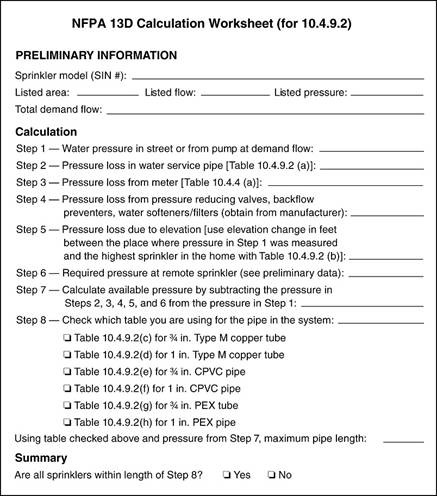
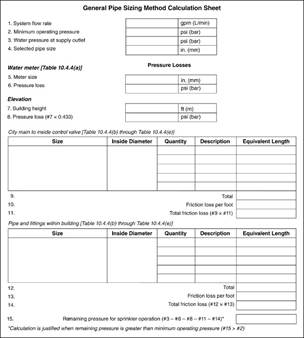
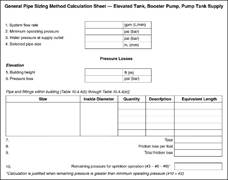
- Two new pipe sizing calculation sheets in Chapter 10. The 2025 edition provides new calculation worksheets supporting the General Pipe Sizing Method (including elevated tank, booster pump, and pump tank supply scenarios) and a new Prescriptive Pipe Sizing Method Worksheet for the alternative method in Section 10.4.9. These tools standardize what was previously a do-it-yourself exercise for many designers.
- Rental dwelling scope clarified (1.1). A new applicability statement confirms that a one- or two-family dwelling used as a rental property can still be appropriately protected with an NFPA 13D system. This eliminates a recurring scope question.
For Installers and Contractors
- Drain piping may terminate at the drain valve (7.2.2.1). New Section 7.2.2.1 and Annex A.7.2.2.1 explicitly permit drain piping to terminate at the drain valve itself, optionally using a temporary hose for discharge. This codifies common field practice rather than introducing a new mandate.
- Sprinklers permitted in unheated, non-living spaces are now an explicit list (7.5.3). The 2022 phrase-based allowance is rewritten as an enumerated list of four permitted types: residential dry pendent, residential dry sidewall, quick-response standard spray dry pendent, and quick-response standard spray dry sidewall.
- LED lighting clarification in temperature-rating table (7.5.6.3). The light-fixture row in Table 7.5.6.3 is now labeled "Light fixture except LED," removing an unnecessarily conservative requirement for low-heat LED fixtures.
For Plan Reviewers and AHJs
- New Annex A.6.5.2 — 5 gpm domestic allowance is per connection. New annex commentary clarifies that the required 5 gpm domestic allowance for common supply pipes applies per connection, removing a recurring point of inconsistency in plan review.
- Removal of explanatory handbook material throughout. Many "Enhanced Content" discussions present in 2022 have been removed in 2025. Reviewers should not interpret the absence of this commentary as a substantive change in intent — the underlying technical rules are largely preserved — but should be prepared to consult the official NFPA 13 (2025) extracts and the NFPA 13D Handbook separately for design-rationale background.
- Updated antifreeze figure (Figure 9.2.3.2.1). Figure 9.2.3.2.1, which governs antifreeze system arrangement, has been updated. Reviewers comparing legacy submittals against current standards should verify against the 2025 figure.
- Annex test-protocol reference change (8.2.5). The annex reference for residential sprinkler test context has been updated from UL 1626 to CAN/ULC 199, reflecting the current Canadian/UL harmonized test standard.
- "Soffits and Cabinets" → "Soffits and Wall Cabinets" (8.2.5.5). A small but precise scope change — base cabinets are no longer covered by this provision, only wall cabinets.
Notable New and Revised Content in 2025
- New defined term: Ceiling Pocket (3.3.2). Establishes a consistent vocabulary for an architectural feature that previously had to be evaluated case-by-case.
- Revised Bathroom definition (3.3.1). Refocused on a "room or compartment dedicated to personal hygiene, containing a toilet, sink, or bathing capability."
- Revised Shadow Area definition (3.3.11). Removes "dry" from the description and broadens obstruction examples to include "other obstruction" in addition to walls and partitions. The definition now extracts directly from NFPA 13 (2025).
- Revised Sprinkler System definitions (3.3.13). 3.3.13.2 (Dry Pipe Sprinkler System) broadens "air or nitrogen" to "air, nitrogen, or other approved gas." 3.3.13.8 (Sprinkler System) is restructured for clarity and adds "waterflow alarm (where required)" to the list of system components.
- Revised Control Valve definition (3.3.15.2). "An indicating valve employed to control (shut) a supply of water to a sprinkler system" becomes "A valve capable of stopping the flow of water to water-based fire protection systems and devices."
- Expanded SI conversion table (Table 1.5.3). The 2025 edition significantly expands the SI conversion factor table.
- Updated referenced editions throughout Chapter 2. NFPA 13, 70, 72, 220, and 750 are all rolled forward. ASTM SI 10 and NFPA 24 (2025) are added as new references.
How to Read the Detailed Comparison That Follows
The remainder of this document is organized in NFPA 13D chapter and section order. For each section that changed between 2022 and 2025, the entry shows the relevant 2022 text, the 2025 text, and where applicable the supporting figures and annex commentary. New sections are flagged "(New in 2025)"; new annex content is identified by clause; and clauses that were renumbered or restructured are tagged accordingly.
Designers should pay particular attention to Chapters 8 and 10, which contain the most substantive technical-design changes (new sloped-ceiling rules for residential sidewalls, the new fuel-fired equipment framework, ceiling pocket definitions, revised closet/pantry coverage, and the new pipe sizing calculation sheets). Installers and contractors should focus on Chapter 7 (drain terminations and dry sprinkler types in unheated spaces). Plan reviewers and AHJs will want to review the new Section 1.1 rental-property language, the updated antifreeze figure in Section 9.2, and the new Annex A.6.5.2 commentary on the 5 gpm domestic allowance.
This synthesis is intended to orient the reader; it is not a substitute for reading the underlying clause text or the official NFPA 13D (2025) standard. Where a clause-level decision turns on subtle wording, the detailed comparison in the sections that follow should be consulted, and the official standard should be the controlling reference.
Chapter 1 – Administration
1.1 SCOPE
2025 adds one new applicability statement:
A one- or two-family dwelling used as a rental property can still appropriately be protected with an NFPA 13D system.
This clarification removes ambiguity around whether rental dwellings fall outside the intended scope of NFPA 13D, helping designers and AHJs apply the standard consistently.
1.4 Equivalency
2025 introduces a new A.1.4 statement clarifying:
Newer editions of NFPA 13D may be used in their entirety even if not yet adopted by a jurisdiction.
This addition reinforces the permissibility of designing to a newer edition when allowed by the AHJ, reducing uncertainty during plan review.
Minor Wording Change in 1.4 — “Shall” instead of “is intended to”.
| 2022 Edition | 2025 Edition |
|---|---|
| “Nothing in this standard is intended to prevent…” | “Nothing in this standard shall prevent…” |
The replacement of advisory phrasing with directive language strengthens enforceability and reduces interpretive ambiguity.
1.5 Units
2025 significantly expands Table 1.5.3 to include a broad set of SI conversion factors.
It is purely a data expansion for convenience and now includes:
- Length
- Area
- Volume
- Fluid capacity
- Flow (L/min)
- Pressure
- Discharge density
- K-factor
- Weight
- Density
- Temperature
- Velocity
- Force (Newton)
- Stress
- Sheet-steel gauge
Chapter 2 – Referenced Publications
2.1 New Technology
Numerous Reference Updates (Edition Changes)
The 2025 edition updates nearly all referenced NFPA, ASME, ASTM, and AWS documents to more recent editions. Examples of major updates:
- NFPA 13 → updated from 2022 to 2025
- NFPA 70 → 2020 → 2023
- NFPA 72 → 2022 → 2025
- NFPA 220 → 2021 → 2024
- NFPA 750 → 2019 → 2023
Additional notes:
- Nearly all ASME fittings standards were updated 3–5 years forward.
- Most ASTM steel pipe, copper tube, and CPVC fitting standards were updated by 1–4 years.
New Referenced Standards Added in 2025
Added in 2025:
- ASTM SI 10 – Metric practice standard
- NFPA 24 (2025) – Private fire service mains
- NFPA 13 (2025) – Added as extract reference in §2.4
Chapter 3 – Definitions
3.1 General
No technical definition changes. Chapter 3 in 2025 is reorganized for clarity and stripped of explanatory handbook material, but the rules governing definitions remain identical to the 2022 edition.
3.3 General Definitions
3.3.1 – Bathroom
Bathroom definition was updated to focus on “lavatory dedicated to personal hygiene, or a water closet, or bathing capability.”
| 2022 Edition | 2025 Edition |
|---|---|
| “room/compartment with lavatory (sink), toilet, or bathing capability” | “room/compartment dedicated to personal hygiene, containing a toilet, sink, or bathing capability.” |
3.3.2 – NEW in 2025: Ceiling Pocket
Added in 2025. Not present in 2022.
Definition (2025)
Architectural feature where a portion of ceiling is at a higher elevation, bounded by the surrounding lower ceiling.
Annex Clarifications
- Ceiling pocket rules do not apply to beam channels.
- Pockets can be “protected” or “unprotected.”
- If the upper surface is within vertical distance limits from the sprinkler, it’s treated as a protected pocket.
3.3.11 — Shadow Area
Similar definition but removes “dry” and expands obstruction examples (“other obstruction”).
| 2022 Edition | 2025 Edition |
|---|---|
| “The dry floor area within the protection area of a sprinkler created by the portion of sprinkler discharge that is blocked by a wall or partition.” | “The floor area within the protection area of a sprinkler created by the portion of sprinkler discharge that is blocked by a wall, partition, or other obstruction. [13, 2025]” |
3.3.13 Sprinkler Systems — General
Minor wording updates in some definitions 3.3.13.2 (Dry Pipe Sprinkler System) and 3.3.13.8 (Sprinkler System).
3.3.13.2 Expands allowable pressurized gas types
| 2022 Edition | 2025 Edition |
|---|---|
| “air or nitrogen” | “air, nitrogen, or other approved gas” |
3.3.13.2 3.3.13.8 Minor re-ordering for clarity
2025 rewrites sentence structure, also adds “waterflow alarm (where required).”
| 2022 Edition | 2025 Edition |
|---|---|
| “A system that consists of an integrated network of piping designed in accordance with fire protection engineering standards that includes a water supply source, a water control valve, and a drain. The portion of the sprinkler system above ground is a network of specifically sized or hydraulically designed piping installed in a building, structure, or area, generally overhead, and to which sprinklers are attached in a systematic pattern. The system is commonly activated by heat from a fire and discharges water over the fire area.” | “A system that is commonly activated by heat from a fire and discharges water over the fire area, that consists of an integrated network of piping designed in accordance with fire protection engineering standards, and that includes a supply source, a water control valve, a waterflow alarm (where required), and a drain. The portion of the sprinkler system above ground is a network of specifically sized or hydraulically designed piping installed in a building, structure, or area, generally overhead, and to which sprinklers are attached in a systematic pattern.” |
3.3.15 Valve
3.3.15.2 Control Valve is one of the few meaningful changes. It has a broader scope as it is NOT limited only to “indicating” valves and it is NOT limited only to sprinkler systems (now all water-based fire protection)
| 2022 Edition | 2025 Edition |
|---|---|
| “An indicating valve employed to control (shut) a supply of water to a sprinkler system.” | “A valve capable of stopping the flow of water to water-based fire protection systems and devices.” |
Chapter 6 – Water Supply
6.5 Common Supply Pipes
2025 edition includes a new, concise A.6.5.2 which clarifies that the required 5 gpm domestic allowance for common supply pipes is per connection.
Chapter 7 – Installation
The single technical enhancement is the new allowance in 7.2.2.1, formally permitting drain piping to terminate directly at the drain valve with an optional temporary hose—reflecting common field practice rather than introducing a new mandate.
7.2 Drains and Test Connections
Update appears in 2025 with the addition of 7.2.2.1 and A.7.2.2.1, which clarifies that the drain piping is permitted to terminate right at the drain valve itself, optionally using a temporary hose for discharge.
7.5 Sprinklers
7.5.3 – Sprinklers permitted into unheated, non-living spaces
2022 Edition: Allowed “listed residential or quick-response standard spray dry pendent or dry sidewall sprinklers” to be extended into unheated areas (phrase-based).
2025 Edition: Rewritten as an explicit enumerated list of permitted types:
- Residential dry pendent
- Residential dry sidewall
- Quick-response standard spray dry pendent
- Quick-response standard spray dry sidewall
7.5.6 – Temperature Ratings
Table 7.5.6.3 minor change:
| 2022 Edition | 2025 Edition |
|---|---|
| Includes “Light fixture” rows with watt ranges (0–250 W, 250–499 W) and required clearances. | The light-fixture row is changed to read “Light fixture except LED” and retains the same distance values for the watt ranges. |
Chapter 8 – Sprinkler Position and Location
8.1.1 Sloped Ceilings – General
Enhanced Content removed. Added 8.1.1.4. Residential Sidewall Sprinklers Under Sloped Ceilings:
2022 Definition:
- NO equivalent section. The standard had no dedicated rule for how sidewall sprinklers must be installed under sloped ceilings.
2025 Definition:
- New section establishing two acceptable installation methods when slope exceeds 2 in 12:
- At high point, discharging down the slope (Fig. 8.1.1.4(a))
- On slopes ≤ 8 in 12 with deflector parallel to slope, discharging across the slope (Fig. 8.1.1.4(b))
The 2025 edition fills a long-standing gap in NFPA 13D by finally outlining how sidewall sprinklers must be oriented under sloping ceilings.
8.2.5 Obstructions to residential sprinklers (general / annex material)
- Annex/intro material: Largely the same explanatory material about intent and test series — very similar wording, but:
- 2022 annex references laboratory test standard UL 1626 (and mentions UL-style test protocol).
- 2025 annex replaces that reference with CAN/ULC 199.
- Version 2025 is more specific regarding cabinets. Instead of using the general term of cabinets it now specifies rules for “Wall Cabinets”.
- 2022: 8.2.5.5 Soffits and Cabinets.
- 2025: 2.5.5 Soffits and Wall Cabinets.
8.3.3 Closets, Linen Closets, Pantries
2022 Edition: Sprinklers shall not be required in clothes closets, linen closets, and pantries that meet all of the following conditions:
- Area ≤ 24 ft²
- Walls/ceiling are surfaced with noncombustible or limited-combustible materials.
2025 Edition: Sprinklers shall not be required in clothes closets, linen closets, or pantries with or without doors that meet all of the following conditions:
- Area ≤ 24 ft² (same)
- Noncombustible or limited-combustible surfaces (same)
- NEW REQUIREMENT:
- “The closets without doors meet the definition of a compartment (3.3.3).”
8.3.5 Fuel Fired Equipment
2025 Added:
- 8.3.5.1.2
- 2022: Where fuel-fired equipment is located beneath an occupied area of the dwelling unit, at least one quick-response intermediate temperature sprinkler shall be installed above the equipment.
- 2025: Where fuel-fired equipment is located within or beneath an occupied area of the dwelling unit, at least one quick-response or residential intermediate temperature sprinkler shall be installed above the equipment.
- 8.3.5.1.3 – Where the installation of a sprinkler is required by 8.3.5.1.2, the sprinkler shall be positioned so that the footprint of the fuel-fired equipment is within the calculated coverage area of the sprinkler.
- 8.3.5.1.4 – Where fuel-fired equipment is installed within a concealed space and a portion of the fuel-fired equipment is exposed to the dwelling unit, sprinkler protection shall not be required within the concealed space.
- 8.3.5.1.5 – Where a chimney or flue from fuel-fired equipment passes through a concealed space, sprinkler protection shall not be required in the concealed space.
Chapter 9 – Protection from Freezing
9.2 Antifreeze Systems
Figure 9.2.3.2.1 has been updated.
| 2022 Edition | 2025 Edition |
|---|---|
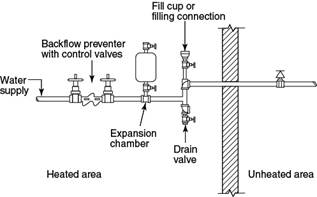 | 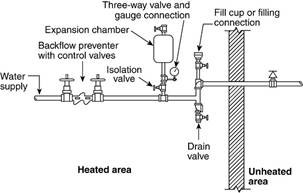 |
Chapter 10 – Discharge and Hydraulic Calculations
10.2 Pipe Sizing
The 2025 edition provides two new calculation sheets.
General Pipe Sizing Method:
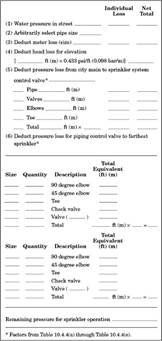
General Pipe Sizing Method Calculation Sheet – Elevated Tank, Booster Pump, Pump Tank Supply:
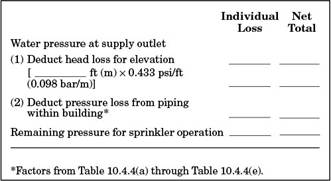
10.4.9 Alternative Method to Hydraulic Calculations (Prescriptive Method)
The 2025 edition provides text that is now clearer and concise by removing the enhanced content. A “Prescriptive Pipe Sizing Method Worksheet” was added.