The 2025 edition of NFPA 13R: Standard for the Installation of Sprinkler Systems in Low-Rise Residential Occupancies reflects a structured update that combines editorial refinement with targeted technical changes. While the core life safety objectives of the standard remain consistent with the 2022 edition, the 2025 release introduces clarified definitions, expanded annex guidance, updated referenced standards, and several new prescriptive requirements that affect design, installation, testing, and maintenance.
This document provides a detailed, section-by-section comparison of NFPA 13R 2022 and 2025, identifying edition roll-forwards, newly added requirements, reorganized language, and technical clarifications. The goal is to help fire protection engineers, designers, contractors, and authorities having jurisdiction clearly understand what has changed, what remains the same, and how those updates may impact real-world residential sprinkler system design and compliance.
Chapter 1 – Administration
1.4 Equivalency
2025 adds Annex A.1.4 clarifying adoption lag and discouraging “mixing provisions.” Supports using a newer edition in full when permitted by the AHJ.
The 2025 edition adds annex guidance to reduce confusion when jurisdictions adopt editions at different times, and it strengthens the rule language in the equivalency statement.
Minor Wording Change in 1.4 — “Shall” instead of “is intended to”.
| 2022 Edition | 2025 Edition |
|---|---|
| “Nothing in this standard is intended to prevent…” | “Nothing in this standard shall prevent…” |
The replacement of advisory phrasing with directive language strengthens enforceability and reduces interpretive ambiguity.
1.5 Units
2025 significantly expands Table 1.5.3 to include a broad set of SI conversion factors.
It is purely a data expansion for convenience and now includes:
- Length
- Area
- Volume
- Fluid capacity
- Flow (L/min)
- Pressure
- Discharge density
- K-factor
- Weight
- Density
- Temperature
- Velocity
- Force (Newton)
- Stress
- Gauge thickness
Chapter 2 – Referenced Publications
Chapter 2 in the 2025 edition reflects a systematic roll-forward of referenced standards. ASTM SI 10 (Standard for Metric Practice) is added as a mandatory referenced publication, reinforcing metric consistency as a requirement rather than guidance. NFPA 24 is newly listed in Section 2.4 (References for Extracts in Mandatory Sections).
2.2 NFPA Publications
- NFPA 13 → updated from 2022 to 2025
- NFPA 20 → 2022 → 2025
- NFPA 22 → 2018 → 2023
- NFPA 24 → 2022 → 2025
- NFPA 25 → 2020 → 2023
- NFPA 82 → 2019 → 2024
- NFPA 101 (Life Safety Code) → 2021 → 2024
- NFPA 220 → 2021 → 2024
- NFPA 750 → 2019 → 2023
- NFPA 5000 → 2021 → 2024
Net change type: Edition roll-forward across the board; no NFPA titles added or removed.
2.3 Other Publications
ASME Publications
No ASME titles added or removed, but multiple edition updates occur:
- ASME A17.1/CSA B44 → updated from 2019 to 2021
- ASME B16.1 → 2015 → 2020
- ASME B16.3 → 2016 → 2021
- ASME B16.4 → 2016 → 2021
- ASME B16.5 → 2017 → 2020
- ASME B16.11 → 2016 → 2021
- ASME B16.18 → 2018 → 2021
- ASME B16.22 → 2018 → 2021
Unchanged editions:
- ASME B16.9 2018
- ASME B16.15 2018
- ASME B16.25 2017
- ASME B36.10M 2018
ASTM Publications
No ASTM titles removed, but several edition updates occur and one new ASTM reference is added:
- ASTM A53/A53M → updated from 2018 to 2022
- ASTM A135/A135M → 2019 → 2021
- ASTM A234/A234M → 2019 → 2023
- ASTM A795/A795M → 2013 (2020) → 2021
- ASTM B32 → 2008 (reapproved 2014) → 2020
- ASTM F437 → 2015 → 2021
- ASTM F438 → 2017 → 2023
- ASTM F442/F442M → 2019 → 2023
Unchanged editions:
- ASTM B43 2020
- ASTM B88 2020
- ASTM B251/B251M 2017
- ASTM B813 2016
- ASTM B813 2019
New editions in 2025:
- ASTM SI 10 / IEEE/ASTM SI 10, American National Standard for Metric Practice, 2016
AWS Publications
- AWS A5.8/A5.8M → updated from 2011 + Amendment 1 (2012) to 2019
Other Publications
- Merriam-Webster’s Collegiate Dictionary → updated from 11th edition (2003) to 11th edition (2020)
Chapter 3 – Definitions
3.1 General
The 2025 edition restructures the single 2022 paragraph into three requirement-style subsections without changing the intent.
| 2022 Edition | 2025 Edition |
|---|---|
| Single paragraph (3.1) covering applicability of definitions, ordinary meanings if undefined, and dictionary source. | Split into three requirements-style subsections 3.1.1–3.1.3 with the same intent:
|
3.1 General Definitions
3.3.1 – Bathroom
Bathroom definition was updated to focus on “lavatory dedicated to personal hygiene, or a water closet, or bathing capability.”| 2022 Edition | 2025 Edition |
|---|---|
| “room/compartment with lavatory (sink), toilet, or bathing capability” | “room/compartment dedicated to personal hygiene, containing a toilet, sink, or bathing capability.” |
3.3.2 – Carport
The 2025 edition revises the carport definition to remove freestanding structures, limiting it to attached covered structures open on at least two sides.| 2022 Edition | 2025 Edition |
|---|---|
| “A freestanding or attached covered structure open on at least two sides…” | “An attached covered structure open on at least two sides…” |
3.3.4 – NEW in 2025: Ceiling Pocket
Added in 2025. Not present in 2022.
Definition (2025)
Architectural feature where a portion of ceiling is at a higher elevation, bounded by the surrounding lower ceiling.
Annex Clarifications
- Ceiling pocket rules do not apply to beam channels.
- Pockets can be “protected” or “unprotected.”
- If the upper surface is within vertical distance limits from the sprinkler, it’s treated as a protected pocket.
3.3.6 – Dwelling Unit
Same core definition; new annex language. A.3.3.6 explicitly says:
Common spaces such as a lounges, group cooking facilities, and group bathrooms that are for use by the occupants of the building should be considered a part of the dwelling unit.
The 2025 update clarifies that shared occupant spaces such as lounges, kitchens, and bathrooms are considered part of the dwelling unit, reducing ambiguity in system design and coverage requirements.
3.3.12 — Shadow Area
Similar definition but removes “dry” and expands obstruction examples (“other obstruction”).| 2022 Edition | 2025 Edition |
|---|---|
| “The dry floor area within the protection area of a sprinkler created by the portion of sprinkler discharge that is blocked by a wall or partition.” | “The floor area within the protection area of a sprinkler created by the portion of sprinkler discharge that is blocked by a wall, partition, or other obstruction. [13, 2025]” |
3.3.14 Sprinkler Systems — General
The 2025 edition refines the sprinkler system definition by clarifying activation language and explicitly adding a required waterflow alarm component where applicable.
Adds “waterflow alarm (where required)” and refines the phrasing (“commonly activated… discharges water…”).
Expands allowable pressurized gas types
| 2022 Edition | 2025 Edition |
|---|---|
| “air or nitrogen” | “Air, nitrogen, or other approved gas under pressure” |
3.3.16 Valve
Control Valve is one of the few meaningful changes. It has a broader scope as it is NOT limited only to “indicating” valves and it is NOT limited only to sprinkler systems (now all water-based fire protection)
| 2022 Edition | 2025 Edition |
|---|---|
| “An indicating valve employed to control (shut) a supply of water to a sprinkler system.” | “A valve capable of stopping the flow of water to water-based fire protection systems and devices.” |
Chapter 5 – System Components
5.1 General
The 2025 edition refines the allowance for replacement of pre-2003 residential sprinklers by explicitly permitting the use of a sprinkler with either an equivalent K-factor (±5 percent) or the next larger K-factor, providing greater flexibility when exact replacements are unavailable. Additionally, sprinkler temperature classification tables are restructured by separating glass bulb and fusible-link devices into distinct tables. Last, the escutcheon requirement is narrowed in wording (now explicitly “recessed, or flush-type” rather than “recessed, flush-type, or concealed” for escutcheons while concealed cover plates still remain explicitly tied to the listed assembly).
5.1.1.2 Sprinkler Replacement
| 2022 Edition | 2025 Edition |
|---|---|
| Replacement permitted with equivalent K-factor (±5%) (with coverage area limit). | Replacement permitted with equivalent K-factor (±5%) or next larger K-factor (still with coverage area limit). |
5.1.1.6 Temperature Characteristics
| 2022 Edition | 2025 Edition |
|---|---|
| One combined table (Table 5.1.1.6.1) containing both fusible link color codes and glass bulb colors in one place, with rating ranges. | Splits into two tables:
|
5.1.1.7 Escutcheons and Cover Plates
| 2022 Edition | 2025 Edition |
|---|---|
| 5.1.1.7.2: Escutcheons used with recessed, flush-type, or concealed sprinklers shall be part of a listed sprinkler assembly. | 5.1.1.7.2: Escutcheons used with recessed, or flush-type sprinklers shall be part of a listed sprinkler assembly. |
5.3 Underground Pipe
5.3.1 – Underground Pipe Smaller Than 4 in. (100 mm)
The 2025 edition maintains the same material allowance but adds clarification and enforceable language requiring underground piping to comply with the adopted plumbing code.
| 2022 Edition | 2025 Edition |
|---|---|
| Permits any pipe acceptable under the adopted plumbing code for underground supply pipe smaller than 4 in. | Retains the same allowance. Adds:
|
5.3.2 – Underground Pipe 4 in. and Larger
| 2022 Edition | 2025 Edition |
|---|---|
| “Underground pipe and tube for underground supply pipe 4 in. (100 mm) and larger nominal dimension shall be in accordance with NFPA 24 when installed between the point of connection and the system riser.” | “Underground supply pipe 4 in. (100 mm) and larger nominal dimension shall be designed and installed in accordance with NFPA 24 when installed between the point of connection and the system riser.” |
5.4 System Types
5.4.2 – Systems in Areas Subject to Freezing
NEW: Listed vacuum systems in accordance with NFPA 13
Chapter 6 – Installation
6.2 Use of Sprinklers
In 2025, the document introduces an explicit rule set for ambient ceiling temperatures exceeding 150°F (66°C) (new 6.2.3.3, requiring high-temperature sprinklers unless modified), and it renumbers the “practices” provisions into 6.2.3.4 while also tying temperature rating selection directly to the new split tables in Chapter 5 (Table 5.1.1.6.1(a) and (b)). There are also smaller but practical clarifications: the heat-source table now explicitly treats light fixtures “except LED”, and the dry-sprinkler annex figures expand to include flexible dry sidewall and flexible dry pendent measurement examples.
6.2.3 Temperature Ratings (major structural change)
| 2022 Edition | 2025 Edition |
|---|---|
| 6.2.3.1 and 6.2.3.2 set ordinary/intermediate selection by ambient ceiling temperature bands. |
|
6.2.3.4 (practices) now ties to Table 5.1.1.6.1(a)/(b)
The 2025 edition splits glass bulb vs fusible link temperature/color tables.
Heat source separation table renumbering and small clarifications.
| 2022 Edition | 2025 Edition |
|---|---|
| Table 6.2.3.4.3 Light fixture | Table 6.2.3.4.3 Light fixture except LED |
6.2.4 Exposed Barrel Lengths (dry sprinklers connected to wet systems)
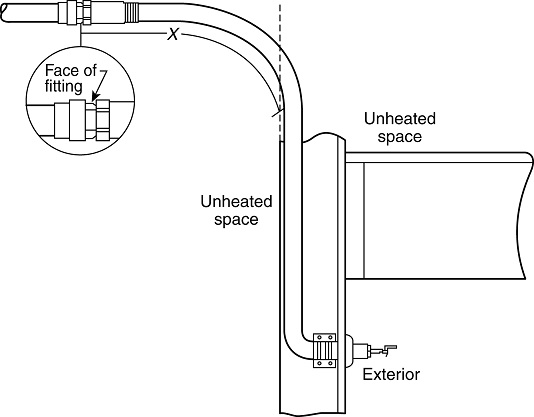
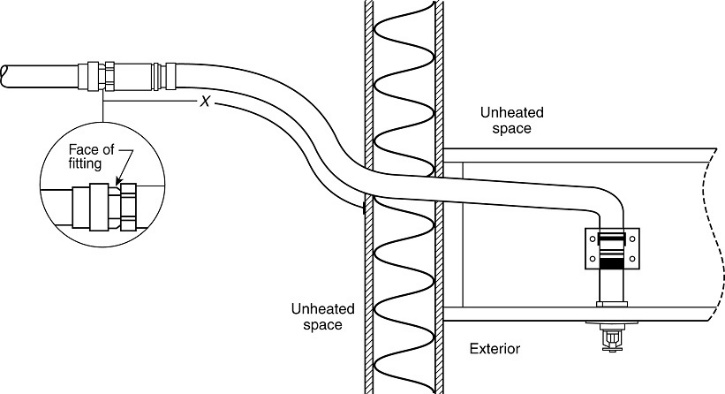
The 2025 edition adds additional measurement examples for flexible dry sidewall and flexible dry pendent:
- Figure A.6.2.4.1(c): where to measure the exposed barrel length for a flexible dry sidewall sprinkler penetrating through a wall.

- Figure A.6.2.4.1(d): where to measure the exposed barrel length for a flexible dry pendent sprinkler penetrating through a ceiling.
6.4 Residential Sprinklers
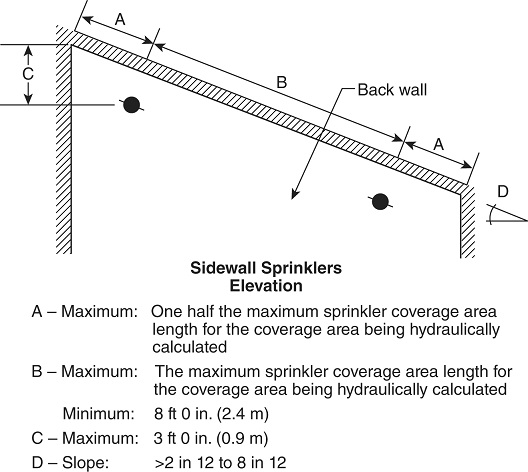
6.4.2 Sloped ceilings
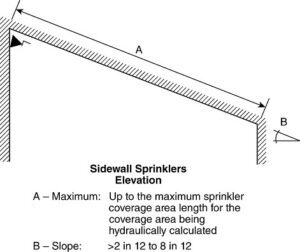
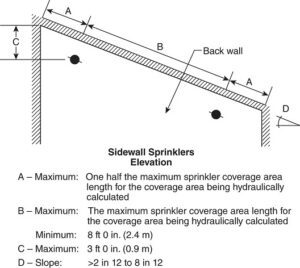
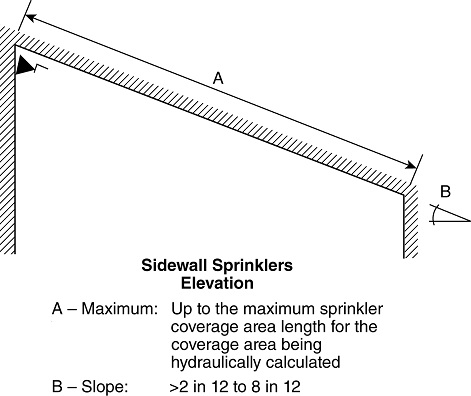
6.4.2.4 (NEW in 2025): Applies when residential sidewall sprinklers are installed under a sloped ceiling where slope > 2 in 12. Adds two permitted configurations:
- Place at high point to discharge downward along the slope.
- Place on slopes ≤ 8 in 12, with deflector parallel to slope, discharging across the slope.
Annex A.6.4.6.3 – Reference change
| 2022 Edition | 2025 Edition |
|---|---|
| References UL 1626 (Residential sprinklers) as the cited fire test context | References CAN/UL/ULC 199 (Automatic sprinklers) and similar standards |
6.4.6.3 Obstructions to residential sprinklers – Soffits and cabinets
| 2022 Edition | 2025 Edition |
|---|---|
| Title/wording: “Soffits and Cabinets” and references “cabinets.” | Title/wording: “Soffits and Wall Cabinets” and references “wall cabinets.” |
6.6 Location of Sprinklers
6.6.2 Bathrooms – Annex A.6.6.2
| 2022 Edition | 2025 Edition |
|---|---|
| bathroom can be just a toilet; adjacent bathrooms are separate rooms/compartments. | retains “toilet-only is still a bathroom,” and adds explicit clarification that where multiple rooms/compartments form a “bathroom area,” each qualifying bathroom is not counted aggregately toward the 55 ft² threshold. |
6.6.3 Closets / linen closets / pantries
| 2022 Edition | 2025 Edition |
|---|---|
Omission permitted for closets/pantries within dwelling units meeting:
| Adds two changes:
|
6.6.5 Open attached exterior features
| 2022 Edition | 2025 Edition |
|---|---|
Defines Type V construction and discusses the rationale for adding exterior balcony protection correlation with model building codes. | Retains Type V definition AND Adds: Even if a Type V building has balconies constructed with noncombustible materials, those balconies still require protection. |
6.6.6 Concealed spaces / attics
Annex A.6.6.6 changed in 2025 by adding:
Spaces with non-fuel-fired equipment and access panels should be considered a concealed space and should not require sprinkler protection.
6.6.9
| 2022 Edition | 2025 Edition |
|---|---|
“6.6.9 Interior Stairwells.” | “6.6.9 Interior Stair Shafts.” |
6.9 Drains
The 2025 edition adds a new requirement clarifying drain sizing for larger system risers. 6.9.2.1 adds:
For system risers sized 2½ in. (65 mm) or larger, the drain piping and valve shall be sized in accordance with NFPA 13.
Chapter 8 – Plans and Calculations
8.2 Hydraulic Calculations
8.2.1 Pipe Sizing
The 2025 edition adds to 8.2.1.1 Combined sprinkler/standpipe hose demand exemption:
Where the sprinkler system is part of a combined sprinkler/standpipe system (Class I or Class III) and the building is sprinklered throughout in accordance with NFPA 13R, no inside hose demand is required at any hose outlets.
Chapter 10 – System Acceptance
10.2 Acceptance Tests
10.2.3 System Operational Tests
The 2025 edition retains the required flow test through the inspector’s test connection but replaces the general performance expectation with two new prescriptive performance requirements.
10.2.3.1.1:
“Mechanical waterflow alarm devices shall be listed for the service and so constructed and installed that any flow of water from a sprinkler system equal to or greater than that from a single automatic sprinkler of the smallest K-factor installed on the system will result in an audible alarm on the premises within 5 minutes after such flow begins and until such flow stops. [13:7.7.1]”
10.2.3.1.2
“Electrical waterflow alarm devices shall be listed for the service and so constructed and installed that any flow of water from a sprinkler system equal to or greater than that from a single automatic sprinkler of the smallest K-factor installed on the system will result in an audible alarm on the premises within 100 seconds after such flow begins and until such flow stops. [13:7.7.2]”
Chapter 11 – Care and Maintenance
11.1 Stock of Spare Sprinklers
11.1.7 – Sprinkler List in Cabinet
The 2025 edition expands and clarifies the sprinkler cabinet list requirements by adding temperature rating, requiring the manufacturer’s sprinkler wrench model number, and specifying quantities both installed in the property and stored in the cabinet, making the documentation more detailed and enforceable compared to 2022.
| 2022 Edition | 2025 Edition |
|---|---|
Sprinkler List in Cabinet:
| Sprinkler List in Cabinet:
|