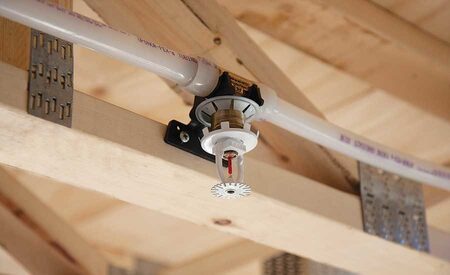
So what exactly is a fire flow test, and how does it affect sprinkler system design?
A fire flow test is a field test used to measure how much water a water system can provide for fire protection. For sprinkler system design, this test shows how much water is actually available so engineers can compare it to how much water the sprinkler system will need to operate properly.
The recommended practice governing the performance of fire flow tests is NFPA 291. While NFPA 291 does not establish sprinkler design criteria, it defines the procedures, measurements, and framework required to develop reliable water supply data suitable for use in sprinkler system hydraulic calculations under NFPA 13.
Purpose of fire flow testing for sprinkler systems
For sprinkler system design, the objective of a fire flow test is to determine how the water distribution system performs under imposed demand and to quantify the relationship between flow and pressure at a given location. This relationship allows the designer to determine whether the water supply can support the required sprinkler system demand, including both flow and pressure, without supplemental equipment such as a fire pump or storage tank.
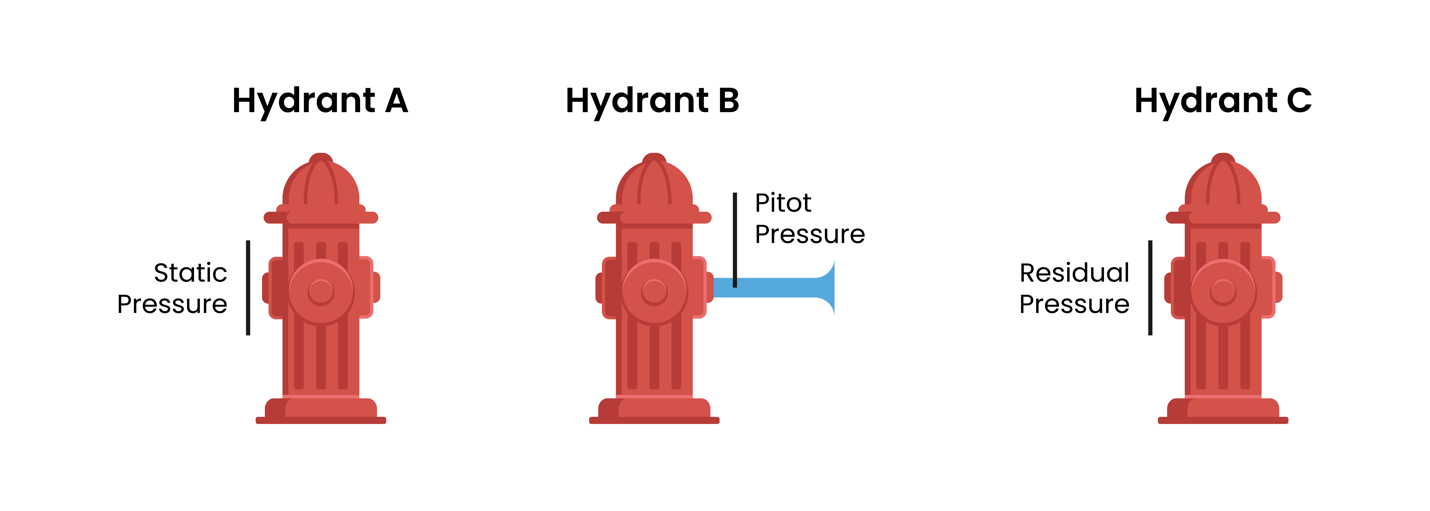
Fire flow testing provides measured values of pitot pressure, residual pressure, and flow rate. These values are not used in isolation. They are used together to characterize system behavior, identify friction losses in the system, and project available flow at specified residual pressures relevant to sprinkler system operation.
Relationship between NFPA 291 and sprinkler hydraulic calculations
NFPA 291 establishes a standardized methodology for conducting fire flow tests so that resulting data can be interpreted consistently and defensibly. For sprinkler designers, the significance of NFPA 291 lies in determining available water supply at the point where the sprinkler system connects to the public or private water system.
NFPA 291 provides guidance on hydrant selection, test layout, flow measurement, pressure measurement, and projection of available flow. These elements directly support the development of the water supply information required for hydraulic calculations. When water supply data are submitted with sprinkler system plans, authorities having jurisdiction frequently expect that the test was conducted using NFPA 291 procedures.
Test intent and applicability to sprinkler design
NFPA 291 differentiates between fire flow tests conducted to evaluate the capacity of a single hydrant and tests conducted to determine available water supply in a water main. This distinction is critical for sprinkler system design.
For sprinkler applications, the test must evaluate the water main supplying the project location. This is done by flowing water from one or more hydrants while measuring the pressure at another nearby hydrant to see how the water supply system responds. Tests that measure flow from a single hydrant without evaluating system pressure response may not provide data suitable for sprinkler hydraulic calculations.
The test setup must be able to show how the water system will perform under the full demand of the sprinkler system.
Test timing and system demand considerations
NFPA 291 emphasizes that fire flow tests should be conducted during periods of high or peak system demand when practicable. Water distribution systems experience significant variation in demand based on time of day, season, and development density. Tests conducted during low demand periods can overstate available pressure and flow.
Engineering judgment is required to assess whether test conditions reasonably represent worst case supply conditions. Designers should evaluate when the test was conducted and whether subsequent changes in system demand, such as additional development or changes in system configuration, may affect the validity of the data.
When flow test data are required, they must typically be conducted within the past 12 months to comply with NFPA 13 requirements for fire sprinkler submittals. Some local jurisdictions may require more recent data, such as tests performed within the last 6 months. Because water system conditions, infrastructure, and overall demand can change, using current and accurate test data is critical for proper system design and approval.
How a Section 4.4 fire flow test is performed
The following sequence summarizes the core procedural elements of a Section 4.4 style fire flow test when performed to determine available water supply for sprinkler system design. The following list is not a substitute for NFPA 291, but a technical orientation for designers evaluating test validity.
- Confirm the test intent is determination of available water supply in a water main for sprinkler design, not evaluation of single hydrant capacity.
- Select a flowing hydrant and a residual hydrant positioned between the flowing hydrant and the larger mains feeding the area supplying the project site.
- Inspect hydrants, outlets, surrounding terrain, and traffic conditions, and establish cones or controls as required for safety and test stability.
- Attach a calibrated pressure gauge to the residual hydrant and record pitot pressure with all hydrants closed.
- Prepare the flowing hydrant with appropriate outlets and stream control devices, then open slowly to flush debris until flow stabilizes.
- Increase discharge until a meaningful residual pressure drop is achieved, commonly at least a 10 percent reduction from pitot pressure.
- While flow is steady, simultaneously record residual pressure at the residual hydrant and pitot pressure at the flowing outlet.
- Document outlet size, pitot location, gauge calibration status, time of test, and any unusual system or site conditions.
- Close the flowing hydrant slowly to minimize pressure surges, then confirm recovery of pitot pressure.
- Use measured pitot pressure, residual pressure, and flow to project available flow at target residual pressures and compare to sprinkler system demand.
Flow measurement accuracy and instrumentation
Accurate flow measurement is essential for reliable fire flow data. NFPA 291 provides detailed guidance on flow measurement techniques, including pitot pressure measurement and the use of calibrated outlets or stream straighteners.
Key technical considerations include preference for 2.5-inch outlets where practicable, proper pitot placement relative to the discharge stream, use of devices with known discharge coefficients when required, and calibration of pressure gauges at intervals not exceeding 12 months. Errors in flow measurement directly affect projected available supply and can lead to incorrect conclusions regarding system adequacy.
Projection of available water supply
Measured pitot pressure, residual pressure, and flow rate are used to project available flow at a target residual pressure using established hydraulic relationships. This projection estimates how much water the system can deliver while maintaining a specified minimum pressure, commonly 20 psi.
The projected available supply point is compared to the sprinkler system demand calculated in accordance with NFPA 13. If the available supply exceeds the system demand at the required pressure, the system may be designed without supplemental pumping. If the available supply is insufficient, additional measures such as a fire pump, tank, or system modification may be required.
NFPA 291 notes that many water authorities and health departments do not permit residual pressures below 20 psi due to concerns related to back siphonage and water quality. Designers must account for these limitations when evaluating supply adequacy.
Clarifications critical to sprinkler design
NFPA 291 makes it clear that you should not combine firefighting hose water demand with sprinkler system demand when evaluating the water supply. Model code fire flow requirements and sprinkler system demands are intended to be calculated and satisfied independently unless otherwise required by the authority having jurisdiction.
This clarification is critical during early project planning, as improper aggregation of demands can result in unnecessary system oversizing or the incorrect assumption that a fire pump is required.
Importance of proper interpretation
Fire flow testing is the primary method by which designers verify that a sprinkler system is compatible with the water supply that will serve it during a fire event. Improper test methods, inadequate pressure drop, outdated data, or misinterpretation of results can lead to undersized systems, delayed approvals, or unexpected infrastructure requirements late in the design process.
When conducted and applied in accordance with NFPA 291, fire flow testing provides a reliable, defensible basis for sprinkler system hydraulic design and review.